

Unlocking a "Panoramic View": The Self-Driving System on Top
Early robot vacuums bumped around aimlessly because they had no "eyes." Today's smart vacuums, however, owe their precision to a small, raised dome on top—their LiDAR Navigation System.
The principle is similar to sonar or radar, but it uses light. The robot spins rapidly, emitting invisible laser beams in all directions. When a laser hits a wall or a table leg, it bounces back. By precisely calculating the time it takes for the light to return, the robot creates a 2D map of the room and locates itself within it in real-time, achieving millimeter-level accuracy for navigation and path planning.
The UNINELL UR3 uses this very LiDAR technology, adapted from the self-driving car industry. It scans and maps your entire home in seconds, accurately plotting every piece of furniture in the app. You can then act like a commander, drawing virtual boundaries to create "no-go zones," steering the UR3 clear of your pet's food bowl or delicate rugs.
Exploring the "Power of the Wind": How Much Suction Do You Actually Need?
When choosing a robot vacuum, suction power is likely the first spec you see. It's measured in Pascals (Pa). In simple terms, the higher the Pa, the greater the negative pressure generated, and the more powerful its ability to pull in dust and debris. While some guides suggest 2500-3000Pa is sufficient for everyday dust, effectively removing stubborn dust mites, pet hair, and large crumbs from deep within carpets requires significantly more power.
The UNINELL UR3 is equipped with a powerful 7000Pa of suction, placing it at the forefront of high-performance cleaning. Whether it's micro-dust in floor crevices, embedded pet hair in your area rugs, or scattered cookie crumbs, the UR3 captures it all in a single pass.
The "Ultimate Dream": How a Vacuum Learns to Empty Its Own Dustbin
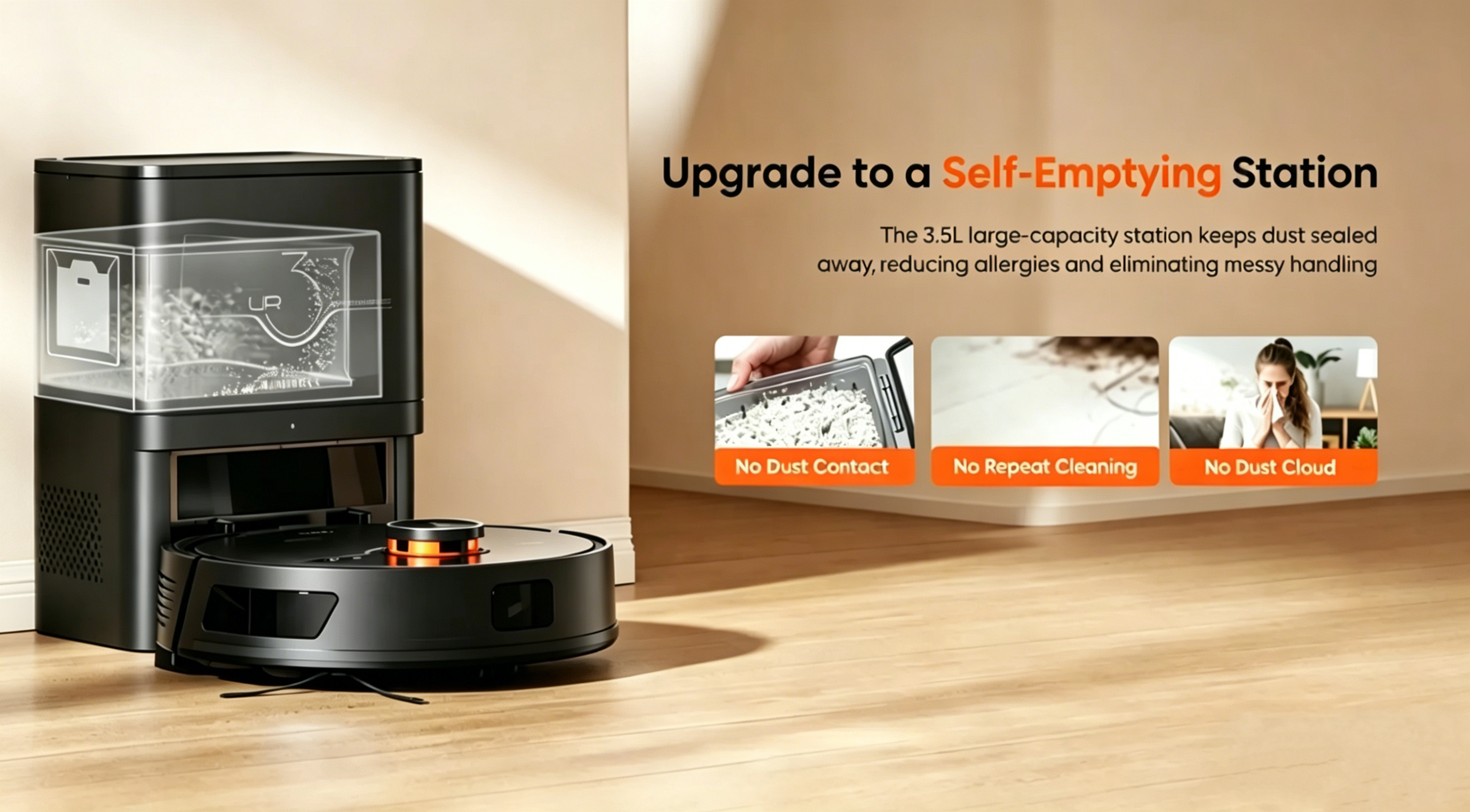
Manually emptying a robot vacuum's dustbin is often the most unpleasant part of ownership. It's messy, and the dust clouds can cause secondary pollution. This is where Self-Emptying Technology comes to the rescue. The process is simple: once the robot finishes cleaning and returns to its base, the station generates a powerful vortex that rapidly transfers all debris from the robot's bin into a large, sealed dust bag inside the station.
The UNINELL UR3, for example, features a self-emptying base with a massive 90-day capacity. This single, sealed bag can hold almost three months' worth of dust and hair, even in a household with pets. During those 90 days, you never have to touch the dirt. When it's finally full, you simply lift the bag's handle—an automatic sealing mechanism ensures a dust-free disposal.
💡 Further reading: Curious if a robot vacuum can completely replace your traditional vacuum? Check out our detailed comparison: Can a Robot Vacuum Really Replace Manual Vacuuming? UNINELL UR1 Review
Cleaning Should Be This Simple
From the "seeing" LiDAR navigation to the "deep-cleaning" 7000Pa suction and the "forget-it" 90-day self-emptying system, the UNINELL UR3 seamlessly integrates these three cutting-edge technologies. It's not just a robot vacuum; it's a comprehensive home cleaning solution designed to free you from the mundane task of floor maintenance.
If you're tired of bending over to vacuum and dealing with dusty bins, it's time to let the UR3 join your home.
Let the UNINELL UR3 handle your whole-home cleaning.
Shop UNINELL UR3 on Amazon Now
💡 Further reading: Want to know how effortless the UR3 is in daily use? Check out this detailed hands-on review: Why You Need a Robot Vacuum: How UNINELL UR3 Makes Cleaning Effortless (Even If You're Lazy)